
Supervised by Prof. Yi Zhang
Ph.D Student in Medical Imaging and Analysis
cyy262511(at)gmail.com
Education

supervised by Prof. Yi Zhang
Experience


I am currently a Ph.D student at the Deep Imaging Group (DIG) at Sichuan University (SCU) in Chengdu, China under the supervision of Prof. Yi Zhang. Previously, I finished my B.Eng in Software Engineering at Sichuan University in June 2021 I received my B.Eng. degree in Software Engineering from Sichuan University in June 2021, ranking 13/264 undergraduate students. Following graduation, I was directly admitted to the Ph.D. program at the College of Computer Science, Sichuan University.
Research keywords include: Medical Imaging and Analysis, Trustworthy AI, Federated Learning, and so on.
Warning
Problem: The current name of your GitHub Pages repository ("Solution: Please consider renaming the repository to "
http://".
However, if the current repository name is intended, you can ignore this message by removing "{% include widgets/debug_repo_name.html %}" in index.html.
Action required
Problem: The current root path of this site is "baseurl ("_config.yml.
Solution: Please set the
baseurl in _config.yml to "News
Research Highlights
FACT: Fuzzy Alignment with Comorbidity Topology for Reliable Multi-Label Medical Image Diagnosis
Yingyu Chen, Yongqiang Huang, Yang Qin, Ziyuan Yang, Lang Yuan, Maosong Ran, Yi Zhang†
International Conference on Machine Learning (ICML)
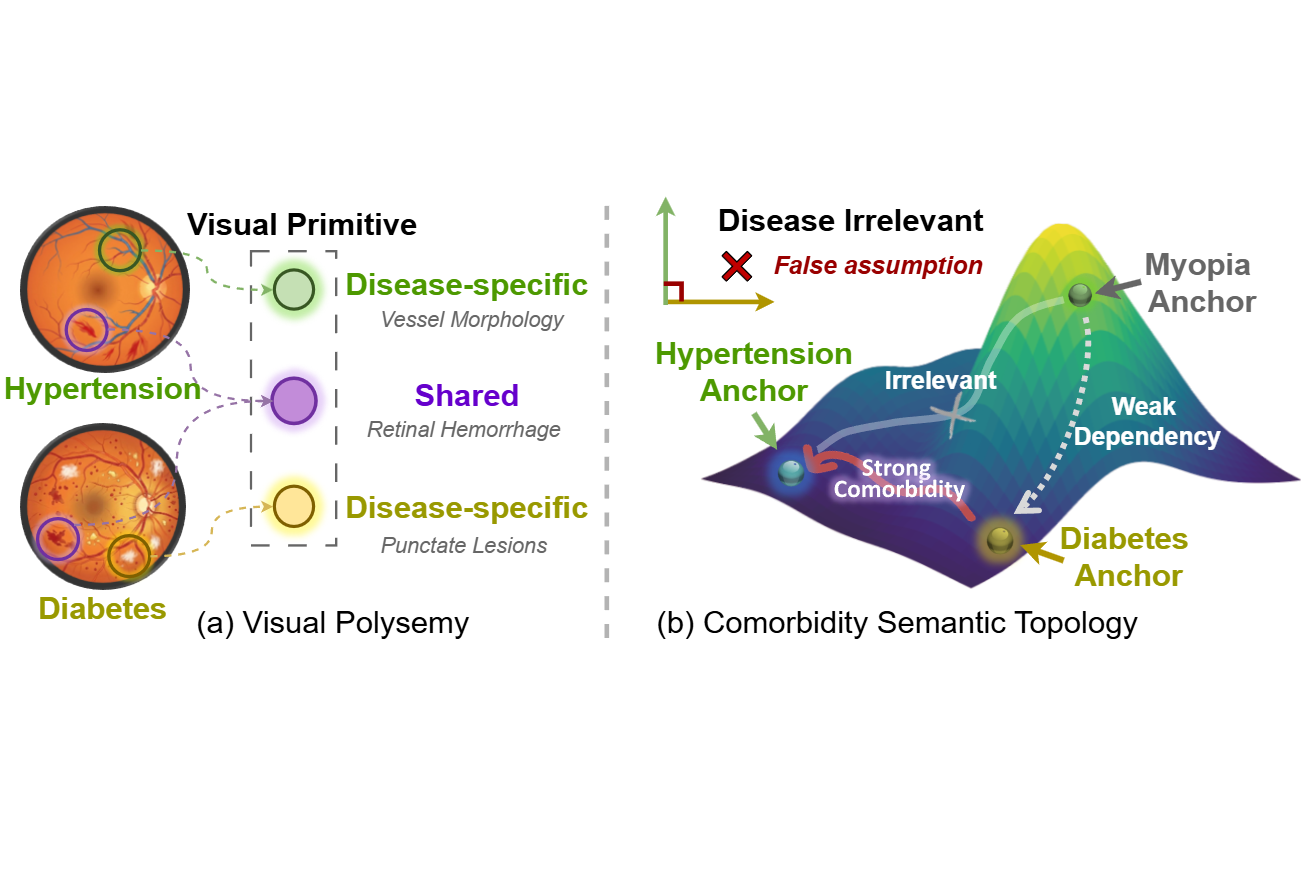
This paper proposes FACT, a framework that reinterprets multi-label medical image diagnosis as a fuzzy alignment problem, leveraging vector quantization to construct atomic visual evidence and a graph convolutional network to embed comorbidity topology, with a metric-based fuzzy membership function derived from RKHS theory.
# medical analysis # multi-label learning # vision-language
FACT: Fuzzy Alignment with Comorbidity Topology for Reliable Multi-Label Medical Image Diagnosis
Yingyu Chen, Yongqiang Huang, Yang Qin, Ziyuan Yang, Lang Yuan, Maosong Ran, Yi Zhang†
International Conference on Machine Learning (ICML)
This paper proposes FACT, a framework that reinterprets multi-label medical image diagnosis as a fuzzy alignment problem, leveraging vector quantization to construct atomic visual evidence and a graph convolutional network to embed comorbidity topology, with a metric-based fuzzy membership function derived from RKHS theory.
# medical analysis # multi-label learning # vision-language
Beyond Class Boundaries: Federated Visual Primitive Sharing with Text-Guided Adaptation
Yongqiang Huang, Yingyu Chen, Tao Wang, Zexin Lu, Zerui Shao, Beibei Li, Yi Zhang†
The ACM Web Conference (WWW)
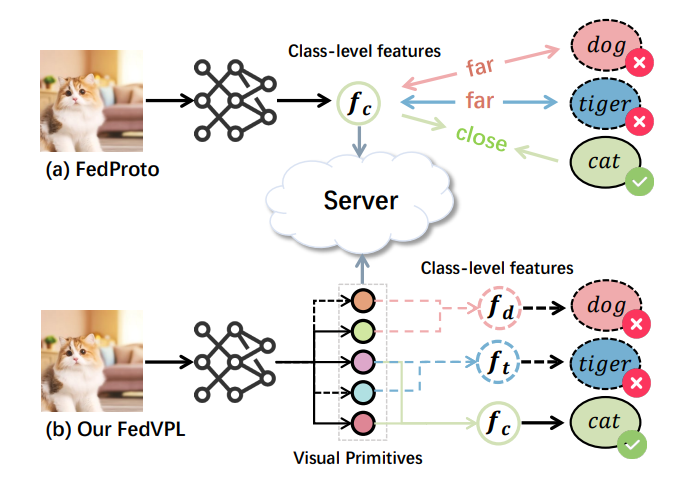
This paper introduces FedVPL, a personalized federated learning framework that shares semantically decomposed visual primitives across clients and leverages text-guided alignment to enhance feature diversity, personalization, and generalization while significantly reducing communication overhead.
# federated learning # vision-language
Beyond Class Boundaries: Federated Visual Primitive Sharing with Text-Guided Adaptation
Yongqiang Huang, Yingyu Chen, Tao Wang, Zexin Lu, Zerui Shao, Beibei Li, Yi Zhang†
The ACM Web Conference (WWW)
This paper introduces FedVPL, a personalized federated learning framework that shares semantically decomposed visual primitives across clients and leverages text-guided alignment to enhance feature diversity, personalization, and generalization while significantly reducing communication overhead.
# federated learning # vision-language
FedPalm: A General Federated Learning Framework for Closed-and Open-set Palmprint Verification
Ziyuan Yang, Yingyu Chen, Chengrui Gao, Andrew Beng Jin Teoh, Bob Zhang, Yi Zhang†
IEEE Transactions on Information Forensics and Security (IEEE T-IFS)
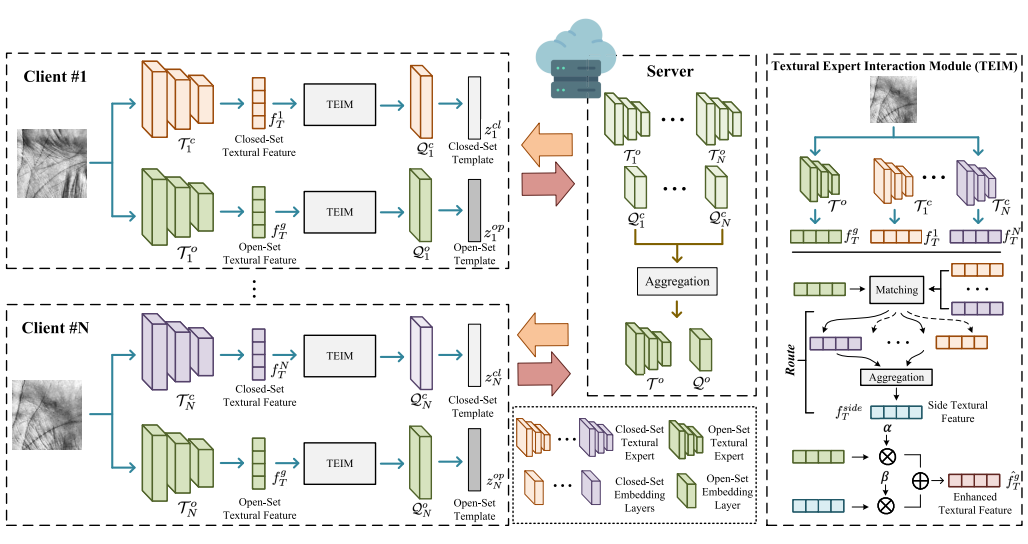
This paper proposes FedPalm, a unified federated learning framework for palmprint verification that combines personalized local textural experts with a shared global expert to achieve robust performance in both closed-set and open-set scenarios while preserving biometric privacy.
# federated learning # biometrics
FedPalm: A General Federated Learning Framework for Closed-and Open-set Palmprint Verification
Ziyuan Yang, Yingyu Chen, Chengrui Gao, Andrew Beng Jin Teoh, Bob Zhang, Yi Zhang†
IEEE Transactions on Information Forensics and Security (IEEE T-IFS)
This paper proposes FedPalm, a unified federated learning framework for palmprint verification that combines personalized local textural experts with a shared global expert to achieve robust performance in both closed-set and open-set scenarios while preserving biometric privacy.
# federated learning # biometrics
Double Banking on Knowledge: A Unified All-in-One Framework for Unpaired Multi-Modality Semi-supervised Medical Image Segmentation
Yingyu Chen, Ziyuan Yang, Zhongzhou Zhang, Ming Yan, Hui Yu, Yan Liu, Yi Zhang†
IEEE Transactions on Biomedical Engineering (IEEE T-BME)
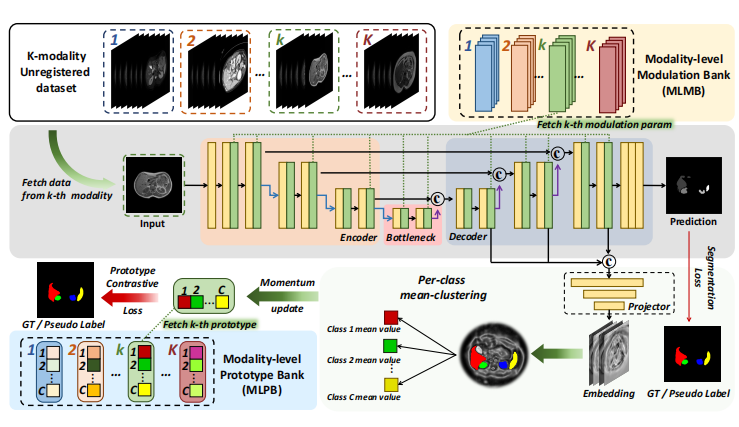
This paper proposes a unified all-in-one framework for unpaired multi-modality semi-supervised medical image segmentation that leverages learnable knowledge banks, modality-adaptive weighting, and dual consistency to capture both modality-invariant and modality-specific features, enabling scalable and robust segmentation across multiple modalities.
# medical analysis # weakly-supervised learning
Double Banking on Knowledge: A Unified All-in-One Framework for Unpaired Multi-Modality Semi-supervised Medical Image Segmentation
Yingyu Chen, Ziyuan Yang, Zhongzhou Zhang, Ming Yan, Hui Yu, Yan Liu, Yi Zhang†
IEEE Transactions on Biomedical Engineering (IEEE T-BME)
This paper proposes a unified all-in-one framework for unpaired multi-modality semi-supervised medical image segmentation that leverages learnable knowledge banks, modality-adaptive weighting, and dual consistency to capture both modality-invariant and modality-specific features, enabling scalable and robust segmentation across multiple modalities.
# medical analysis # weakly-supervised learning
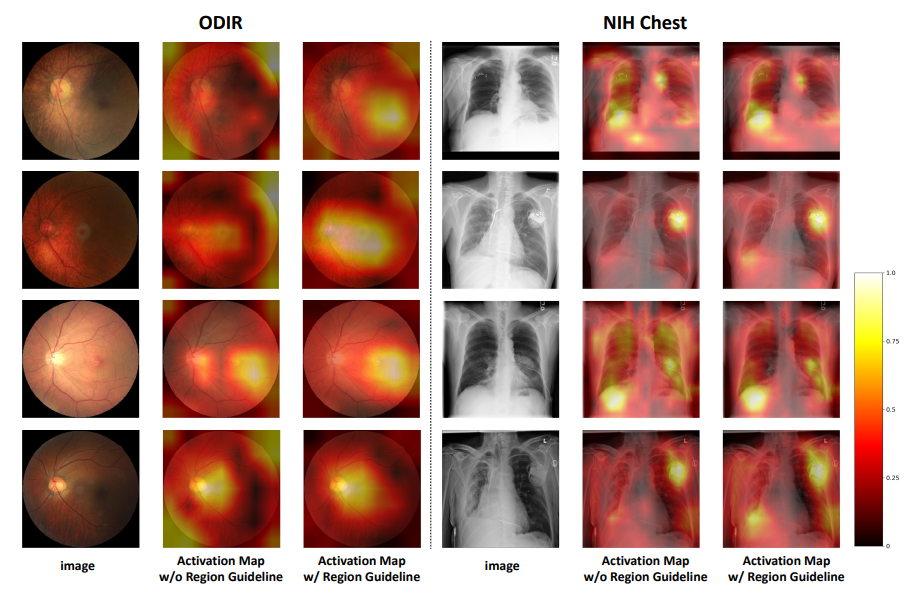
Trustworthy Disentangled Framework for Multi-Label Medical Image Classification with Multimodal Refinement
Yingyu Chen, Ziyuan Yang, Yongqiang Huang, Xulei Yang, Siyong Yeo, Yi Zhang†
IEEE International Conference on Bioinformatics and Biomedicine (IEEE BIBM)
This paper proposes a trustworthy disentangled framework for multi-label medical image classification that uses multi-CLS token transformers with multimodal refinement and a novel evidence-based loss to capture disease-specific features, model inter-disease relationships, and provide reliable predictions with uncertainty estimates.
# medical analysis # trustworthy AI # multi-label learning
Trustworthy Disentangled Framework for Multi-Label Medical Image Classification with Multimodal Refinement
Yingyu Chen, Ziyuan Yang, Yongqiang Huang, Xulei Yang, Siyong Yeo, Yi Zhang†
IEEE International Conference on Bioinformatics and Biomedicine (IEEE BIBM)
This paper proposes a trustworthy disentangled framework for multi-label medical image classification that uses multi-CLS token transformers with multimodal refinement and a novel evidence-based loss to capture disease-specific features, model inter-disease relationships, and provide reliable predictions with uncertainty estimates.
# medical analysis # trustworthy AI # multi-label learning
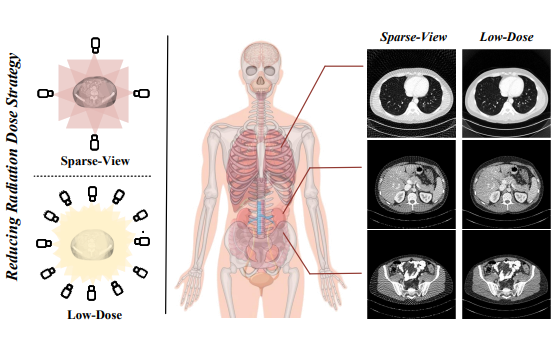
Patient-Level Anatomy Meets Scanning-Level Physics: Personalized Federated Low-dose CT Denoising Empowered by Large Language Model
Ziyuan Yang, Yingyu Chen, Zhiwen Wang, Hongming Shan, Yang Chen, Yi Zhang†
IEEE/CVF Conference on Computer Vision and Pattern Recognition (CVPR)
This paper introduces SCAN-PhysFed, a personalized federated learning framework for low-dose CT denoising that leverages scanning- and anatomy-level physics-informed prompts, guided by a medical large language model, to achieve robust and generalizable reconstruction across diverse scanning protocols while preserving patient privacy.
# federated learning # medical imaging # LLM
Patient-Level Anatomy Meets Scanning-Level Physics: Personalized Federated Low-dose CT Denoising Empowered by Large Language Model
Ziyuan Yang, Yingyu Chen, Zhiwen Wang, Hongming Shan, Yang Chen, Yi Zhang†
IEEE/CVF Conference on Computer Vision and Pattern Recognition (CVPR)
This paper introduces SCAN-PhysFed, a personalized federated learning framework for low-dose CT denoising that leverages scanning- and anatomy-level physics-informed prompts, guided by a medical large language model, to achieve robust and generalizable reconstruction across diverse scanning protocols while preserving patient privacy.
# federated learning # medical imaging # LLM
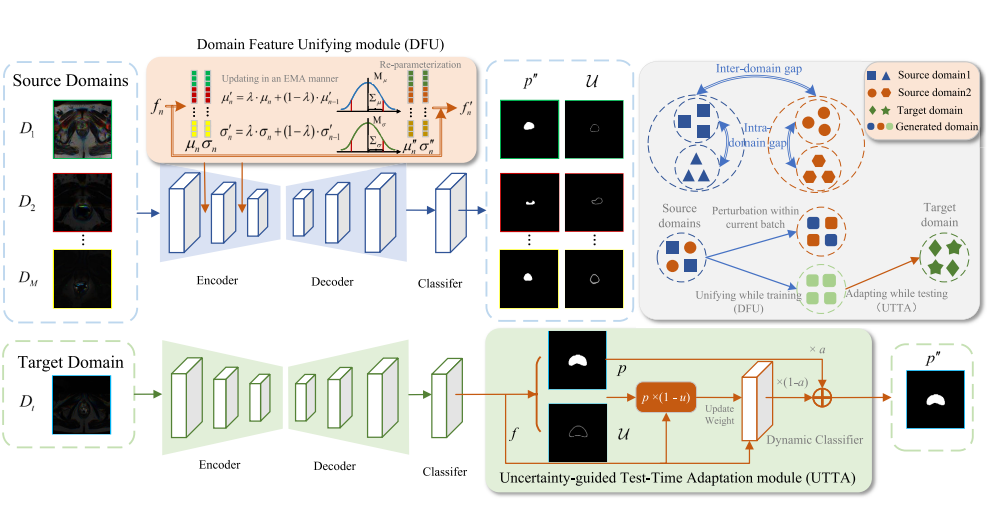
UniAda: Domain Unifying and Adapting Network for Generalizable Medical Image Segmentation
Zhongzhou Zhang, Yingyu Chen, Hui Yu, Zhiwen Wang, Shanshan Wang, Fenglei Fan, Hongming Shan, Yi Zhang†
IEEE Transactions on Medical Imaging (IEEE T-MI)
This paper proposes UniAda, a generalizable medical image segmentation framework that unifies multi-source domains during training and dynamically adapts to unseen target domains at test time using feature statistics and uncertainty-guided adaptation, achieving robust cross-domain performance.
# medical image segmentation # domain adaptation
UniAda: Domain Unifying and Adapting Network for Generalizable Medical Image Segmentation
Zhongzhou Zhang, Yingyu Chen, Hui Yu, Zhiwen Wang, Shanshan Wang, Fenglei Fan, Hongming Shan, Yi Zhang†
IEEE Transactions on Medical Imaging (IEEE T-MI)
This paper proposes UniAda, a generalizable medical image segmentation framework that unifies multi-source domains during training and dynamically adapts to unseen target domains at test time using feature statistics and uncertainty-guided adaptation, achieving robust cross-domain performance.
# medical image segmentation # domain adaptation